There are places where hiking is mainly about reaching a viewpoint, climbing a mountain, or enjoying a beautiful landscape. Then there are places where the trail itself feels like a journey through centuries of human history. Inishmore, the largest of Ireland’s three Aran Islands, belongs firmly in the second category.
Known in Irish as Inis Mór, Inishmore lies off the coast of County Galway in the Atlantic Ocean. The island is famous for dramatic sea cliffs, traditional stone walls, windswept landscapes, sandy beaches, ancient forts, early Christian ruins, and narrow roads that wind through a landscape that has retained much of its distinctive character.
For hikers, what makes Inishmore particularly special is the way its natural scenery and history are woven together. A walk across the island can take you past prehistoric monuments, medieval churches, ancient stone enclosures, traditional fields, and coastal cliffs overlooking the Atlantic. The landscape is not simply something to look at—it provides clues about the people who lived here thousands of years ago.
Inishmore is also part of the Wild Atlantic Way, making it an appealing destination for travelers who want to combine coastal scenery with cultural and historical exploration. The island is about 8 kilometers off the coast of County Galway and is connected to the mainland by ferry services.
If you enjoy hikes where there is something meaningful to discover around almost every corner, Inishmore deserves a place on your travel list.
Why Inishmore Is So Special for History Hikers
Inishmore’s appeal comes from its unusual combination of geology, archaeology, religion, agriculture, and traditional island life.
The island forms part of the same limestone landscape associated with the Burren. That underlying geology has shaped almost everything visitors see, from the exposed rocky ground to the distinctive stone walls dividing fields. The harsh Atlantic environment also helped create a landscape that feels rugged and timeless.
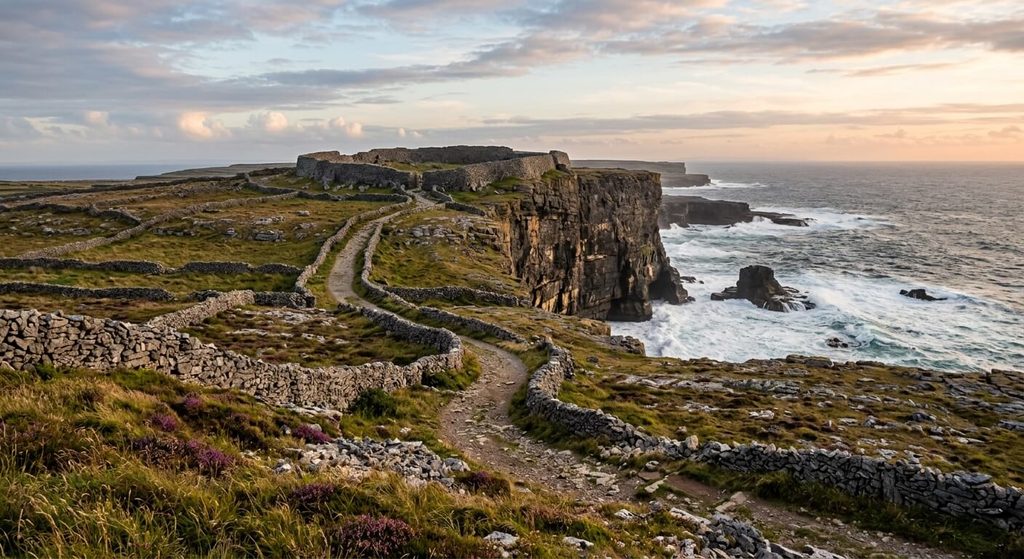
Walking across Inishmore, you may notice that the island doesn’t have the appearance of a conventional countryside destination. Instead of large forests, extensive farmland, or densely developed areas, you encounter a patchwork of small fields separated by countless dry-stone walls.
These walls are one of the defining features of the Aran Islands. They also provide an important reminder of how generations of islanders adapted to difficult conditions and made productive use of limited land.
Beyond the landscape, Inishmore contains an extraordinary concentration of archaeological and religious sites. Among the most important are Dún Aonghasa, Dún Dúchathair, the Seven Churches, and several other ancient monuments scattered across the island.
That means an ordinary walk can become a history lesson without requiring you to spend the entire day inside a museum.
Dún Aonghasa: The Historic Hike You Shouldn’t Miss
If you only have time for one historic hike on Inishmore, make it the walk to Dún Aonghasa.
Dún Aonghasa is one of Ireland’s most famous prehistoric monuments and is dramatically positioned on the edge of an Atlantic cliff. The fort is more than 3,000 years old, making the walk to it an opportunity to experience a site that predates many of the historic structures visitors normally associate with Ireland.
The walk from the visitor centre to the fort is roughly 1 kilometer. Although relatively short, the terrain is rocky and uneven, and the route rises toward the cliff-top monument. Strong walking shoes are recommended.
But the destination is only part of the experience.
As you approach the fort, the landscape becomes increasingly dramatic. The Atlantic stretches out in front of you, while the cliffs drop sharply toward the sea. At the fort itself, enormous dry-stone walls surround the inner enclosure.
One of the most fascinating features is the chevaux-de-frise, a dense band of jagged stones positioned outside the fort. These defensive stones would have made approaching the fort considerably more difficult for potential attackers. The site also contains evidence of ancient houses, burials, and prehistoric metalworking.
The fort’s position is extraordinary. Rather than being hidden inland, it appears to confront the Atlantic directly.
What to See on the Dún Aonghasa Hike
Keep an eye out for:
- The prehistoric stone fort itself
- Massive dry-stone defensive walls
- The chevaux-de-frise defensive stones
- Remains of ancient circular structures
- The dramatic Atlantic cliffs
- Rocky limestone terrain
- Long-distance coastal views
- The archaeological visitor centre and exhibitions
The cliffs are also one of the reasons you should take care while exploring. The fort sits beside an approximately 87-meter drop, and there is no protective barrier along the cliff edge.
The views are spectacular, but the cliffs should always be treated with respect, particularly in strong winds or wet weather.
Walk Through the Landscape Around Kilmurvey
Kilmurvey is another excellent area to explore if you want to combine scenery, history, and walking.
The area is close to Dún Aonghasa and offers access to some of Inishmore’s most attractive coastal scenery. Kilmurvey Beach is particularly striking, with its pale sand and clear water contrasting with the island’s rugged limestone landscape.
The journey toward the western and southern parts of the island reveals one of the most distinctive aspects of Inishmore: the relationship between people and the land.
As you walk, look beyond the obvious attractions. The small fields enclosed by dry-stone walls are themselves part of the island’s cultural landscape. These walls stretch across the countryside, creating a remarkable geometric pattern that looks especially impressive from higher ground.
You may also encounter traditional cottages, livestock, rocky paths, and small roads that make the island feel very different from mainland Ireland.
For hikers interested in landscape history, these ordinary-looking features are worth slowing down to appreciate.
Explore the Seven Churches
Another important historical destination is Na Seacht dTeampaill, or the Seven Churches.
Despite its name, visitors today will not find seven intact churches standing together. The site was once an important pilgrimage destination during the Middle Ages, and two principal church buildings remain: Teampall Bhreacáin, or St. Brecan’s Church, and Teampall an Phoill, also known as the Church of the Hollow.
Walking around the site offers a completely different experience from visiting Dún Aonghasa.
Dún Aonghasa transports you deep into prehistoric Ireland, while the Seven Churches provides a window into the island’s later Christian and medieval history.
The remains are surrounded by the same rugged landscape that defines Inishmore, making the site particularly atmospheric. As you explore, consider how different the island must have looked when pilgrims, monks, scholars, and travelers were making their way here centuries ago.
The site is a reminder that Inishmore was not only a place of prehistoric settlement. It later became an important centre of Christian activity and pilgrimage.
What to Look For at the Seven Churches
During your visit, look for:
- The surviving medieval church structures
- Stone ruins and foundations
- Medieval architectural details
- Ancient crosses and carved stones
- The surrounding fields and stone walls
- Evidence of the site’s former importance as a pilgrimage destination
For anyone interested in the religious history of Ireland, this is one of the most rewarding stops on the island.
Dún Dúchathair: A Dramatic Alternative to Dún Aonghasa
Dún Aonghasa may be the most famous fort on Inishmore, but Dún Dúchathair, often called the Black Fort, offers another fascinating opportunity to hike through the island’s prehistoric landscape.
Located on the southern coast, Dún Dúchathair occupies a dramatic position close to the edge of the cliffs. Centuries of coastal erosion have left parts of the fort appearing perilously close to the sea.
The fort’s defensive wall is particularly impressive. The dry-stone construction consists of several layers, with terraces and steps incorporated into the structure. Inside the enclosure are remains of clocháns, or traditional stone dwellings.
Outside the fort are more examples of chevaux-de-frise, the strategically positioned stones that made approaching the enclosure difficult.
This makes Dún Dúchathair an excellent stop for travelers who want to see another example of Inishmore’s prehistoric fortifications without simply repeating the Dún Aonghasa experience.
Why Visit the Black Fort?
Dún Dúchathair can feel more remote and mysterious than its better-known counterpart.
There is something compelling about standing among the ancient stones while looking toward the Atlantic. The combination of archaeological remains, cliffs, waves, and exposed landscape makes the site one of the island’s most memorable places for history-minded hikers.
It also demonstrates that Dún Aonghasa was not an isolated structure. Inishmore contains several ancient forts, showing how important fortified settlements were to the island’s past.
Follow the Dún Eochla Loop
You don’t have to hike directly to one archaeological attraction to experience Inishmore’s history.
The Lúb Dún Eochla loop provides an opportunity to experience a broader section of the island. The route is approximately 8.9 kilometers and begins and ends around Kilronan. It passes through the island’s distinctive countryside and includes historic features along the way.
This type of route is ideal for travelers who want the journey itself to be the attraction.
Instead of simply walking from one landmark to another, you get a sense of how the island’s archaeological sites fit into the wider landscape.
Along the way, you can expect:
- Stone-walled fields
- Narrow island roads and lanes
- Historic ruins
- Open countryside
- Limestone terrain
- Views across the island
- Traditional buildings
- Coastal scenery
The route is a reminder that history on Inishmore isn’t confined to a handful of famous monuments. It is spread throughout the landscape.
Take on the Longer Cill Mhuirbhigh Loop
For hikers looking for a more substantial walk, Lúb Cill Mhuirbhigh is another option.
This loop is approximately 14.7 kilometers and is classified as a moderate walking route. It begins and ends at Cill Ronain, or Kilronan, and takes approximately 4.5 hours according to Discover Ireland.
The route passes through several different landscapes and includes opportunities to see archaeological and cultural features.
One of the advantages of a longer loop is that it allows you to slow down and experience the island rather than simply ticking off attractions.
You can stop to examine stone walls, look toward the Atlantic, explore historic sites, or simply appreciate the quiet character of the island.
The route also includes access toward areas associated with Dún Aonghasa and offers an optional detour toward Poll na bPéist, better known as the Wormhole.
Visit Poll na bPéist, the Wormhole
Poll na bPéist is one of Inishmore’s most unusual natural features.
Known as the Wormhole, it is a naturally formed rectangular pool near the coast. Its almost geometric appearance makes it seem as though someone carved the shape directly into the limestone.
The Wormhole is a good example of why hiking on Inishmore is about more than archaeology. The island’s natural geology creates attractions that are every bit as memorable as its ancient monuments.
When visiting coastal locations such as this, conditions matter. The Atlantic can be powerful, and visitors should remain well away from dangerous edges and exposed areas.
The attraction is best appreciated as part of the landscape rather than as a place to take unnecessary risks.
Look for Traditional Stone Walls
One of the easiest things to overlook on Inishmore is also one of the most important: the stone walls.
Thousands of dry-stone walls divide the island into small fields. They are a defining feature of the Aran landscape and help tell the story of generations of islanders who worked with a challenging environment.
While hiking, take time to notice how the walls are constructed without conventional mortar. Their irregular appearance adds character to the landscape and creates a visual connection between the island’s modern countryside and its past.
The walls also make excellent photography subjects.
On a clear day, the contrast between gray limestone, green grass, blue water, and the Atlantic sky can create some of the most recognizable images of the Aran Islands.
Watch for Wildlife and Wildflowers
History may be one of Inishmore’s biggest attractions, but nature is never far away.
The limestone environment supports a variety of plant species, including rare wildflowers. Discover Ireland notes that Inishmore’s landscape is home to rare flowers such as gentians and orchids.
Birdwatchers can also find plenty to observe around the island.
Near the coast, keep an eye toward the water for seals and watch the cliffs and fields for seabirds. The island’s relatively open landscape makes wildlife spotting a natural part of a hike.
This combination of natural and historical attractions is one of the biggest reasons Inishmore works so well as a hiking destination.
You can begin your day examining prehistoric stonework and finish it watching wildlife along the Atlantic coast.
Discover the Island Around Kilronan
Kilronan is the main village and an important starting point for exploring Inishmore.
Many visitors arrive by ferry and begin their island adventure here. From Kilronan, you can walk, cycle, take a traditional pony and trap, or arrange other forms of transportation to reach different parts of the island.
Cycling can be particularly convenient for visitors who want to cover more ground, but walking provides a slower and more immersive experience.
Walking allows you to notice small details that can easily be missed when traveling by vehicle: stone cottages, walls, old lanes, wildflowers, grazing animals, and distant archaeological sites.
If your goal is specifically to hike through history, consider building your day around walking rather than treating hiking as a short activity between sightseeing stops.
Inishmore and The Banshees of Inisherin
Modern visitors may recognize Inishmore from the movie The Banshees of Inisherin.
Although the fictional island of Inisherin does not exist, parts of the movie were filmed on Inishmore and Achill Island. Dún Aonghasa appears prominently in the Inishmore landscape, giving movie fans another reason to explore the island.
The movie connection adds a modern cultural layer to an island already rich in history.
However, even if you have never seen the film, the scenery stands on its own. The rugged cliffs, stone walls, cottages, roads, and open Atlantic views are unmistakably atmospheric.
For film enthusiasts, visiting locations associated with the movie can add another dimension to a hike.
What Should You See on a History Hike in Inishmore?
If you’re planning a trip specifically around the island’s history, consider putting these attractions on your list:
1. Dún Aonghasa
The essential stop for first-time visitors. This prehistoric cliff-top fort combines archaeology with spectacular Atlantic scenery.
2. Dún Dúchathair
A fascinating alternative ancient fort with dramatic coastal views and impressive defensive walls.
3. The Seven Churches
An important medieval religious and pilgrimage site that offers a glimpse into Inishmore’s Christian heritage.
4. Traditional Dry-Stone Walls
These may not have a single famous name, but they are among the most distinctive features of the island’s cultural landscape.
5. Kilmurvey Beach
A beautiful coastal stop that adds a relaxing natural element to a day of historical exploration.
6. Poll na bPéist
A remarkable geological feature where the island’s limestone landscape meets the Atlantic.
7. Kilronan
The island’s main settlement and a convenient starting point for exploring Inishmore.
8. Ancient Ruins and Lesser-Known Monuments
Don’t limit your attention to the famous landmarks. Inishmore contains archaeological remains throughout the island, and longer walks provide opportunities to encounter less-publicized historic features.
How to Prepare for Hiking Inishmore
The island may not appear particularly mountainous, but that doesn’t mean every hike is easy.
The terrain can be rocky and uneven, particularly around archaeological sites and coastal areas. Weather can also change quickly, and Atlantic winds can make exposed locations considerably more challenging.
Good footwear is therefore important.
For Dún Aonghasa in particular, official guidance recommends boots or strong walking shoes because the route includes rising ground and rough natural rock. Visitors should also be extremely cautious near the cliff edge.
Before setting out, consider bringing:
- Sturdy walking shoes or hiking boots
- Waterproof clothing
- Warm layers
- Water
- Snacks
- A charged phone
- Sun protection
- A map or reliable route information
- Extra clothing for changing weather
Don’t underestimate the wind. Even on a day that begins pleasantly, exposed coastal sections can feel much colder.
How Long Should You Spend on Inishmore?
A day trip can give you a taste of the island, but staying longer allows you to experience it at a much more relaxed pace.
If you only have one day, prioritize Dún Aonghasa and choose another nearby historical or natural attraction such as the Seven Churches, Dún Dúchathair, Kilmurvey Beach, or Poll na bPéist.
If you have more time, consider taking one of the island’s longer walking routes.
For example, the Dún Eochla loop is approximately 8.9 kilometers, while the Cill Mhuirbhigh loop is approximately 14.7 kilometers.
A longer stay also gives you the chance to explore without constantly watching the clock for your return ferry.
The Best Way to Experience Inishmore’s History
Perhaps the best approach is to resist the temptation to rush.
Inishmore rewards travelers who slow down.
Instead of simply photographing Dún Aonghasa and leaving, spend time looking at the construction of the walls. Notice the relationship between the fort and the cliff. Look at the defensive stones. Imagine the effort required to build such structures without modern machinery.
When walking past an old church, think about the pilgrims who once traveled across this same landscape.
When passing between dry-stone walls, consider the generations of islanders who built and maintained them.
When standing above the Atlantic, remember that these cliffs have been exposed to the same ocean forces for thousands of years.
That perspective transforms a sightseeing trip into a genuine historical journey.
Final Thoughts: A Hike Through Thousands of Years
Inishmore is one of those rare destinations where history doesn’t feel separated from the landscape.
You don’t need to walk into a museum to find the past. You can encounter it along a country lane, inside a stone enclosure, beside an ancient church, or on a cliff overlooking the Atlantic.
Dún Aonghasa provides the dramatic centerpiece, with its prehistoric fortifications and extraordinary cliff-top setting. Dún Dúchathair offers another perspective on ancient island fortifications. The Seven Churches reveals Inishmore’s medieval Christian heritage, while the island’s stone walls and traditional landscape demonstrate how generations of people adapted to life on the Aran Islands.
At the same time, the natural scenery makes every walk memorable. Limestone fields, wildflowers, beaches, cliffs, seabirds, seals, and the Atlantic Ocean continually compete for your attention.
That is what makes Inishmore such a rewarding place to hike through history.
Whether you spend a few hours walking to a prehistoric fort or dedicate several days to exploring the island’s longer trails, you’ll find that the best sights are not always the ones marked with the largest signs. Sometimes they are the stone walls stretching toward the horizon, the ruins hidden beside a quiet lane, or the view that suddenly appears when a trail reaches the coast.
For travelers who want their hikes to offer more than exercise, Inishmore delivers something special: the opportunity to walk through a living landscape where thousands of years of Irish history remain visible beneath your feet.
The written content on this page was generated by ChatGPT.